
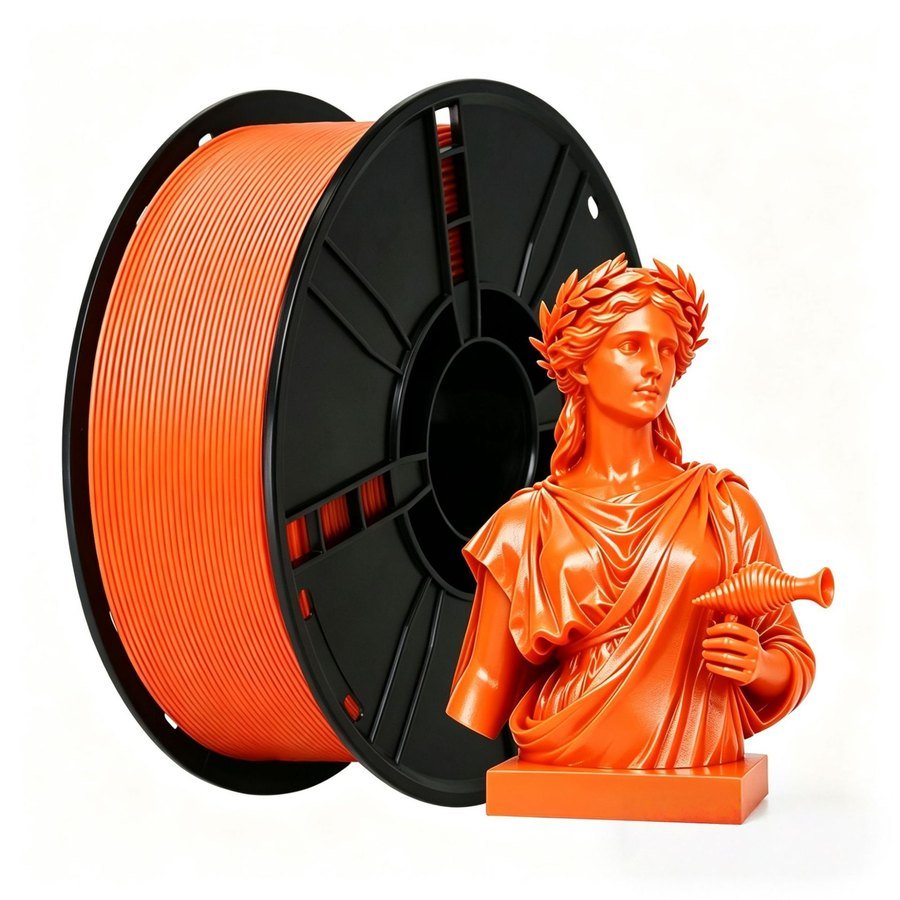
Flexible filament is the grade buyers discover late and then use constantly. Shore 95A TPU sits in the useful middle: soft enough to seal and damp, firm enough to print on a direct-drive machine without a fight.
Where 95A fits
| Application | Why TPU 95A |
|---|---|
| Gaskets and seals | Compresses and recovers; prints in shapes a mould cannot justify |
| Bumpers and feet | Absorbs impact and grips surfaces |
| Vibration damping | Isolates small motors and sensors |
| Wearables and straps | Flexes without cracking; textile-like feel at thin walls |
| Living hinges | Survives repeated flexing that snaps rigid plastics |
Printing it without pain
- Direct drive beats Bowden. A short, constrained filament path is the single biggest reliability factor.
- Slow down. Flexible filament buckles under aggressive retraction and speed.
- Minimise retraction — often the best setting is very little or none, with travel moves tuned instead.
- Dry it. TPU absorbs moisture and prints with voids when wet.
- Wider nozzle helps on functional parts; 0.6 mm reduces back-pressure and print time.
What to specify when sourcing in bulk
- Hardness — Shore 95A is not the same as 85A or 98A; state the scale and value.
- Diameter tolerance and consistency — soft filament is harder to hold dimensionally, so gauge data matters more.
- Moisture control — vacuum sealing with desiccant, and a stated moisture limit at packing.
- Spool compatibility — flexible filament feeds poorly from some spool and AMS configurations; confirm hub and width.
- Color consistency — for consumer SKUs, a batch ΔE limit belongs in the specification.
Volume and pricing reality
TPU is usually a lower-volume, higher-margin line than PLA or PETG. That shapes sourcing: buyers typically stock fewer colors, prefer 1 kg spools for handling, and value consistency over the last few percent of price. If you are supplying an industrial customer, the batch report and moisture data are worth more than the discount.
VOXFIL supplies TPU 95A with TDS, SDS and lot-level batch reports, in standard and custom colors — see the TPU page or request color samples.
Frequently asked questions
What is TPU 95A used for?
Seals and gaskets, bumpers and feet, vibration damping, wearables and living hinges — applications that need flex and recovery rather than rigidity.
Do I need a direct-drive extruder for TPU?
It is strongly recommended. A short filament path prevents buckling, which is the main cause of failed flexible-filament prints. Bowden setups can work with 95A but need much slower speeds and minimal retraction.
Why is flexible filament harder to keep in tolerance?
Soft polymers are more difficult to hold dimensionally during extrusion and winding, so diameter variation is higher than in rigid grades. Ask for gauge data and a measured distribution rather than a single tolerance figure.