
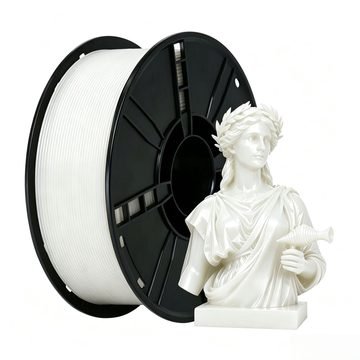
Sustainability questions have moved from marketing to procurement. In 2026 the request is not "do you have a green filament?" — it is a list: recycled content percentage, packaging composition, and evidence for each claim. Here is what buyers actually ask and what suppliers can honestly answer.
What buyers ask for
| Request | What a credible answer looks like |
|---|---|
| Recycled content | A stated percentage with the source stream (post-industrial or post-consumer) and how it is verified |
| Bio-based content | Polymer type and bio-based share, with the certification route where one exists |
| Spool recyclability | Material, whether it is widely recyclable, and whether a refill option exists |
| Packaging data | Weight and material composition per SKU — driven by regulations such as the EU's PPWR |
| End-of-life | Practical guidance: industrial composting for some grades, mechanical recycling for others |
Claims that hold up — and ones that do not
- Holds up: "contains X% post-industrial recycled content, verified by [route]", "cardboard spool, widely recyclable", "PLA is industrially compostable under the applicable standard".
- Does not hold up: "100% eco-friendly", "biodegradable" without a standard or environment, "carbon neutral" without a defined boundary and offset documentation.
Buyers increasingly know the difference, and a vague claim is a liability in an audit.
The performance trade-off, stated honestly
- Recycled PLA can vary more batch to batch than virgin resin; expect tighter incoming inspection.
- Recycled content often reduces elongation slightly, so parts that flex may need a different grade.
- Color is harder to hold on recycled streams — a realistic ΔE limit may be wider than 1.5.
- Cost is not automatically lower; collection and reprocessing can make recycled resin dearer than virgin.
Sourcing it without greenwashing
- Ask for the recycled-content declaration and who verified it.
- Request batch reports on the recycled grade specifically — variation is the main risk.
- Confirm packaging composition in writing so your own reporting is accurate.
- Pilot a small order and test print behavior before listing the SKU as a flagship.
VOXFIL supplies standard and matte ranges on recyclable cardboard spools, can state packaging composition per SKU, and provides grade-specific TDS/SDS and batch reports so sustainable claims rest on data. For recycled-content programs, ask the team what is currently available rather than assuming every grade has a recycled variant.
Frequently asked questions
Is PLA biodegradable?
PLA is generally described as industrially compostable under the applicable standards rather than biodegradable in a home environment or landfill. The distinction matters, and specific claims should reference the standard and the conditions.
Does recycled filament perform as well as virgin filament?
It can come close, but batch variation is usually higher and elongation may be slightly lower. Expect tighter incoming inspection and a wider realistic color tolerance than with virgin resin.
What sustainability information should a filament supplier provide?
Recycled or bio-based content with the verification route, packaging weight and material composition per SKU, spool recyclability and refill options, and honest guidance on end-of-life for the grade.