
North America remains the largest single regional market for 3D printing filament. Third-party analysts put the regional market at roughly USD 846.9 million in 2025 (Fortune Business Insights), with the wider global filament market projected to grow at a double-digit compound rate through the early 2030s. For importers the practical question is not the headline growth rate — it is which channel you sell through and what your landed cost actually is.
What is actually driving volume in 2026
- Print farms and service bureaus — the fastest-growing buyer type. They buy on repeat cycles and care about batch-to-batch consistency more than headline price.
- Education and makerspaces — seasonal, priced per kilogram, sensitive to clogging and warping complaints.
- Industrial and defense-adjacent prototyping — pulls engineering grades: PA-CF, PC, ASA.
- Retail private label — brands that want their own spool, box and color formulas rather than generic stock.
Channel structure: where margin actually sits
| Channel | Typical buyer | What they need from a factory |
|---|---|---|
| Import distributor | Regional wholesaler, 3PL | Container pricing, mixed SKUs, reliable ETD |
| Retail / private label | Amazon & Shopify brands | Spool + label + carton artwork, color hold, COA |
| Direct to print farm | 10–60 machine farms | Repeat batches, fast restock, tolerance data |
| Industrial / OEM | Manufacturer, integrator | TDS, dimensional report, PPAP-style consistency |
Duty and landed cost: the part most quotes get wrong
Filament is generally classified as plastic monofilament. In the United States the relevant heading is HTS 3916; published rate tables show a general (MFN) duty around 5.8% for 3916.10.00, and Chinese-origin goods have in recent years also carried additional Section 301 duties (reported at +25%). Trade measures change often — confirm the current rate and any exclusions with your customs broker before you commit to a price.
Landed cost is rarely just duty. Build the model from:
- FOB unit price × quantity
- Ocean or air freight + insurance
- Duty, merchandise processing fee, harbour fees
- Customs brokerage and drayage
- Inland delivery and 3PL receiving
VOXFIL quotes FOB, CIF and DDP so you can compare the same basket on identical terms — see container and wholesale terms.
What to audit before a container order
- Dimensional control method — inline laser gauging vs sample-only inspection. Ask for the measured distribution, not a single number.
- Batch traceability — can the factory tie a spool back to a production lot and a test report?
- Document pack — TDS, SDS and RoHS/REACH declarations for the exact grade, not the factory's general brochure.
- Color control — ΔE limits per batch if you sell under your own brand.
- Loading plan — carton dimensions, pallets per container, net vs gross weight.
Regional logistics reality
For US and Canadian importers, filament at 14 kg per carton is heavy relative to volume, so containers are usually weight-limited before they are volume-limited. A 40 ft HQ typically lands in the region of 1,800 cartons depending on palletising; confirm the exact plan with your supplier because mixed SKUs and pallet patterns change it.
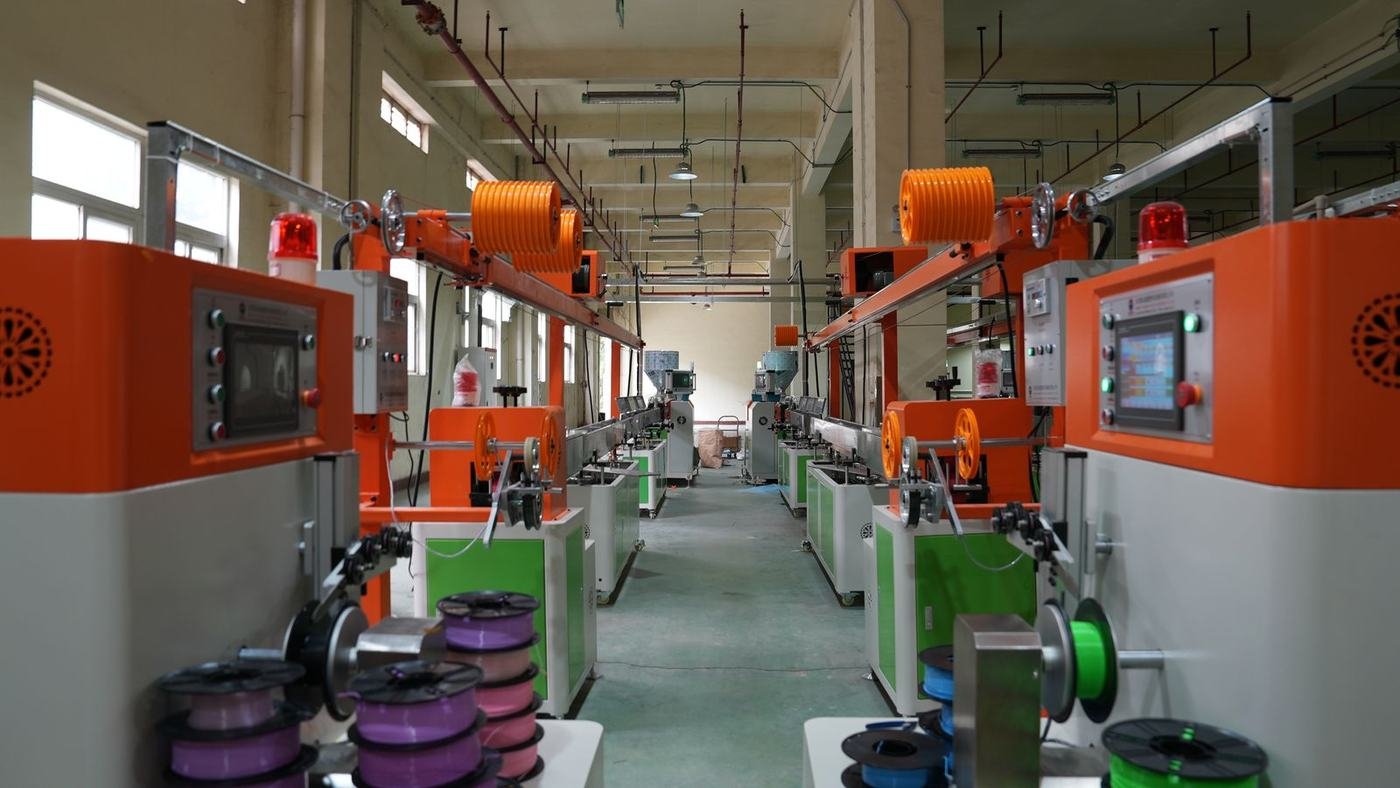
VOXFIL publishes a container loading guide and photographs the production floor (see the factory tour) so buyers can audit the line that will run their order.
Frequently asked questions
How big is the North American filament market?
Third-party analysts estimated the North American 3D printing filament market at approximately USD 846.9 million in 2025, holding the largest regional share globally. Treat vendor estimates as directional and check the latest published report for your planning.
What duty applies to imported 3D printer filament in the US?
Filament generally enters under HTS heading 3916 (plastic monofilament). Published tables show a general MFN rate near 5.8% for 3916.10.00, with additional Section 301 duties possible on Chinese-origin goods. Rates and exclusions change — confirm with a licensed customs broker.
Should a US buyer import a full container or start with pallets?
Start with a pallet or LCL trial to validate color, tolerance and packaging, then move to FCL once the SKU mix and reorder cycle are proven. The trial cost is small compared with a container that misses spec.